

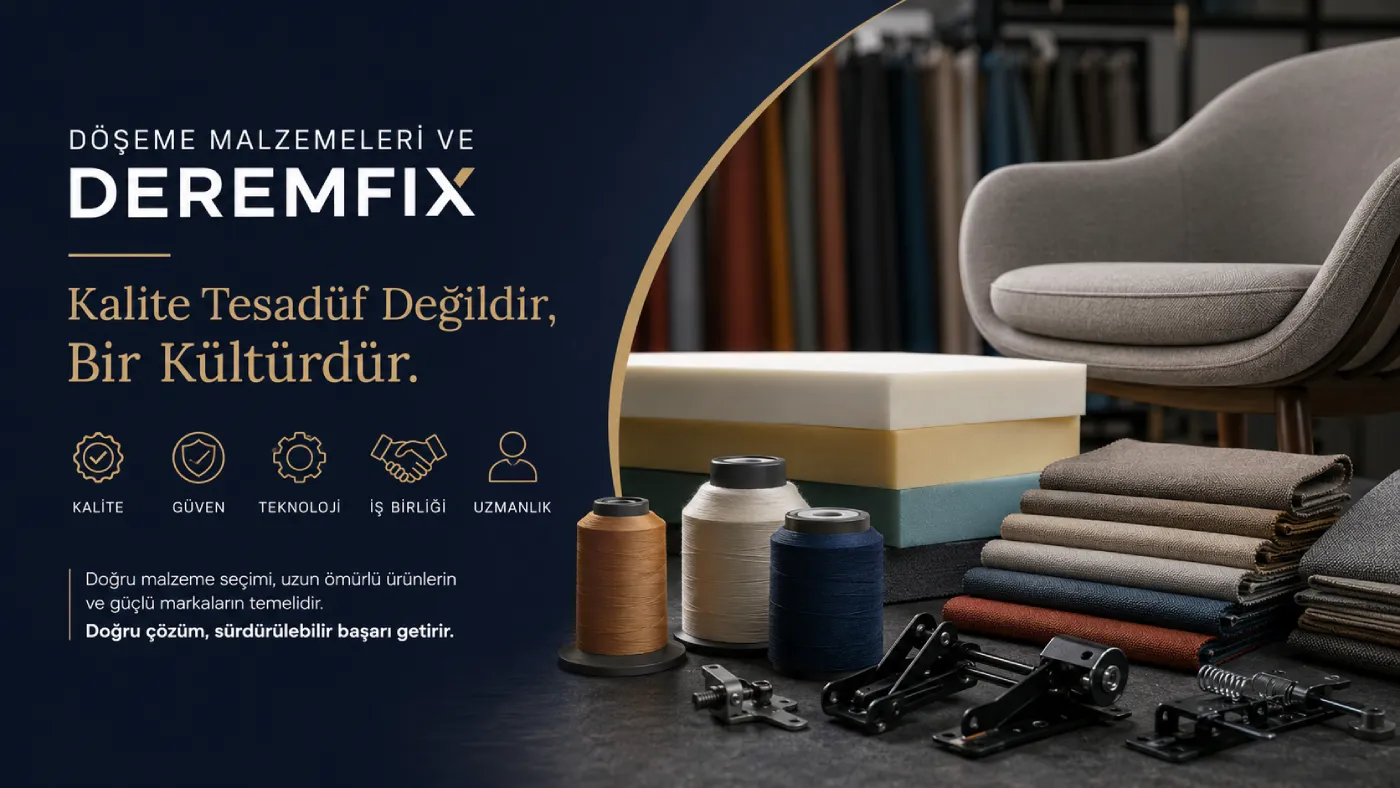
Quality is never an accident—it is a culture.
Dear craftsmen, R&D specialists, purchasing managers, contractors, architects and furniture manufacturers,
What you are about to read is not copied from a technical website, rewritten from marketing brochures or generated from generic industry content.
Every word comes from experience.
For more than 22 years, I have worked in the upholstery materials industry, including 16 years with one of Turkey's leading suppliers of upholstery components. During that time, I had the opportunity to work alongside some of the country's largest furniture manufacturers, as well as small workshops, architects, contractors, purchasing departments, R&D teams and entrepreneurs.
I have visited hundreds of production facilities.
Sometimes I was there simply to observe.
Sometimes to offer technical support.
Sometimes to solve production problems.
And sometimes to prevent mistakes before they became expensive.
One situation repeated itself more often than any other.
During the project approval stage, premium materials were presented to clients. Architects and designers showcased products that demonstrated quality, comfort and durability.
However, once production started, those same materials were quietly replaced with lower-cost alternatives.
On paper, the savings looked attractive.
In reality, the consequences almost always appeared months later.
More warranty claims.
More service calls.
Customer complaints.
Loss of brand reputation.
And eventually, higher costs than if the correct material had been chosen from the beginning.
After seeing this happen countless times, I have repeated the same message to manufacturers, architects, contractors and project owners:
The cheapest material is rarely the most economical choice.
Reducing production costs by sacrificing quality almost always costs far more in the long run.
That is not an opinion.
It is the conclusion of two decades spent inside factories.
Upholstery Materials Are More Than Just Materials
Many people associate upholstery with fabric.
In reality, upholstery is an entire engineering system.
When manufacturing sofas, armchairs, seating systems, sofa beds or storage beds, every hidden component influences the customer's experience.
Furniture mechanisms.
Storage bed lifting systems.
Sofa bed mechanisms.
Zig-zag springs.
Plastic furniture components.
Connection fittings.
Elastic webbing.
Industrial upholstery adhesives.
Support materials.
Technical textiles.
These are not simply parts assembled together.
Together, they determine how comfortable, durable and reliable a piece of furniture will be for years to come.
That is why upholstery represents much more than appearance.
It represents comfort.
Engineering.
Durability.
Ergonomics.
Quiet operation.
Safety.
And above all...
It represents the promise your brand makes to every customer.
Every day your products are tested.
Every time someone sits down.
Every time a storage bed is opened.
Every time a sofa converts into a bed.
Every movement either strengthens or weakens your customer's confidence in your brand.
Most customers never see the mechanism inside a sofa.
They never notice the spring beneath the foam.
They never think about the adhesive holding the upholstery together.
But they experience the quality of those components every single day.
Hidden components ultimately become visible through performance.
Three Types of Manufacturers
Throughout my career, I have noticed that manufacturers generally fall into three categories.
This has nothing to do with company size.
It has everything to do with mindset.
1. Manufacturers Focused Only on Production
These companies produce large volumes.
Their factories rarely stop.
Every discussion revolves around reducing costs.
Purchasing departments are under constant pressure to negotiate lower prices, longer payment terms and faster deliveries.
Innovation is often viewed as an unnecessary expense.
R&D exists, but rarely influences purchasing decisions.
New materials are ignored because the current products appear "good enough."
Initially, this strategy seems successful.
Production continues.
Orders arrive.
Cash flow looks healthy.
Meanwhile, competitors continue investing in new materials, better mechanisms, stronger polymers and more efficient production technologies.
The market evolves.
Their products do not.
Eventually they realize something important:
The competition didn't suddenly become better.
It had been improving quietly for years.
Unfortunately, by the time this becomes obvious, catching up is often extremely difficult.
2. Reliable but Conservative Manufacturers
This group builds quality furniture.
They use reliable materials.
Their customers are generally satisfied.
They have earned respectable reputations.
However, they are often reluctant to embrace change.
Their philosophy usually sounds familiar.
"We've always done it this way."
"We've never had problems before."
While this approach minimizes risk, it also limits growth.
Many of these manufacturers could become industry leaders if they spent more time evaluating new technologies, testing innovative materials and collaborating with suppliers who bring genuine technical expertise.
Even so, they remain valuable contributors to the furniture industry because they understand the importance of consistent quality.
3. Manufacturers Who Never Stop Learning
This is the group I admire the most.
These companies never assume they know everything.
Whenever they discover a new product, they don't reject it because it costs more.
Instead, they ask a different question.
"Why is it better?"
They request samples.
They perform testing.
They review technical documentation.
They study durability reports.
They compare material density.
They evaluate performance instead of simply comparing prices.
Most importantly, purchasing decisions are never made by one person alone.
Engineering teams participate.
Production managers contribute.
Purchasing specialists evaluate.
Owners listen.
Different perspectives lead to better decisions.
These companies understand that innovation has a cost.
So does engineering.
So does durability.
Comfort.
Silence.
Reliability.
Instead of competing by selling the cheapest furniture, they compete by delivering greater value.
As a result, they experience fewer warranty claims, fewer customer complaints and stronger long-term profitability.
Many of today's leading furniture brands share this mindset.
Why DEREMFIX Was Founded
Everything I have learned throughout my career eventually led to one question.
If we know what causes problems in furniture production, why should we continue accepting them as normal?
That question became the foundation of DEREMFIX.
Our goal has never been to become another supplier that simply offers products from a catalog.
We wanted to become a solution partner.
A company that understands manufacturing challenges before they become production problems.
A company that helps customers make better decisions—not simply cheaper ones.
Of course, competitive pricing matters.
Every manufacturer has budgets, cost targets and purchasing objectives.
We understand that.
But there is one thing you should never expect from DEREMFIX:
We will never try to be the cheapest supplier in the market.
Instead, we focus on something much more valuable.
Providing the right product.
The right engineering.
The right performance.
The right balance between quality, durability and cost.
Because we believe that true value is not measured by the purchase price.
It is measured by how the product performs over thousands of cycles, years of daily use and countless customer experiences.
Whether it is a furniture mechanism, a sofa bed mechanism, a storage bed lifting system, an upholstery adhesive, a plastic furniture component or a connection fitting, every product we offer must satisfy one simple requirement:
It must create value beyond its price.
Every Component Matters
Many manufacturers underestimate the importance of components that remain hidden inside the finished product.
Customers rarely see a mechanism.
They don't notice a connector.
They never ask about the density of a plastic part.
Few people know which adhesive was used during production.
But they notice something else.
They notice how the sofa feels after two years.
They notice whether the storage bed opens smoothly every morning.
They notice whether a reclining mechanism still operates quietly after thousands of movements.
They notice whether the furniture still feels solid years after purchase.
These experiences define product quality far more than beautiful fabrics or attractive finishes.
The visible parts create the first impression.
The hidden parts create the lasting impression.
That is why component selection should never be based solely on price.
Every decision made during product development affects the reputation of the finished furniture.
Innovation Is An Investment, Not A Cost
Throughout my career I have met purchasing managers who viewed innovation as an unnecessary expense.
I have also met others who understood that innovation is one of the safest long-term investments a manufacturer can make.
The difference between those two companies becomes obvious after a few years.
One spends its time solving warranty claims.
The other spends its time developing new products.
One negotiates every supplier for a lower price.
The other searches for better solutions.
One reacts to market changes.
The other helps create them.
Technology continues to evolve.
Materials improve.
Manufacturing methods become more efficient.
Sustainability expectations increase.
Customer expectations become higher every year.
Manufacturers who continue learning and adapting will always outperform those who resist change.
Innovation is not about buying the newest product.
It is about remaining curious enough to ask:
"Can this improve what we already produce?"
That simple question has transformed many successful manufacturers into industry leaders.
Our Commitment
At DEREMFIX, every product we introduce must answer an important question:
Will this help our customers build better furniture?
If the answer is yes, we believe it deserves a place in our portfolio.
We continuously evaluate products based on technical performance, durability, manufacturing efficiency and long-term reliability—not simply on their purchase price.
Our mission is to help manufacturers reduce service calls, improve customer satisfaction and strengthen their brands through better engineering decisions.
We believe trust is earned over time.
Every successful project.
Every reliable product.
Every satisfied customer.
These are the foundations upon which long-term partnerships are built.
That is exactly the type of relationship we want to build with every company that chooses DEREMFIX.
A Final Thought
Furniture is not manufactured for a showroom.
It is manufactured for everyday life.
Every chair is sat on.
Every sofa carries weight.
Every storage bed is opened.
Every mechanism moves.
Every connection is tested.
Every adhesive bond is challenged.
Every single day.
That is why choosing the right components is never a minor decision.
It is one of the most important investments a manufacturer can make.
A low-cost solution may reduce today's purchasing budget.
But it can easily become tomorrow's warranty claim.
Or next year's damaged reputation.
Or the reason a customer never returns.
Great furniture is rarely defined by what people can see.
It is defined by everything they cannot.
The engineering.
The materials.
The craftsmanship.
The attention to detail.
The commitment to quality.
These are the things that transform an ordinary product into a trusted brand.
At DEREMFIX, this belief guides every decision we make.
We are committed to helping manufacturers create furniture that lasts longer, performs better and delivers greater value—not only on the day it leaves the factory, but throughout its entire service life.
Because quality is never an accident.
It is a culture.
And we look forward to building that culture together—with our customers, our partners and everyone who believes that lasting success begins with making the right decisions from the very beginning.
Sincerely,
Written by
Mehmet ÇETİNKAYA
DEREMFIX Technical Editorial Team
The DEREMFIX Technical Editorial Team consists of industry professionals with extensive experience in furniture manufacturing, upholstery, mattress production, contract textiles, furniture mechanisms and industrial adhesives. Our mission is to provide manufacturers, architects, purchasing professionals and project managers with reliable technical information that helps them select the right materials, improve production efficiency and optimize manufacturing processes.